

World Health Summit 2026
The World Health Summit 2026, held under the theme “From Crisis to Resilience: Innovating for Health”, will take place from October 11–13, 2026, in Berlin, Germany, and online. As the leading platform for global health, the World Health Summit convenes leaders from politics, science, civil society, and the private sector from around the world to catalyze collaborative and innovative solutions for key global health priorities. This year’s Summit will foster cross-sectoral exchange, evidence-based dialogue, and impactful partnerships to explore how to turn innovation into more equitable, resilient, and future-ready health systems.
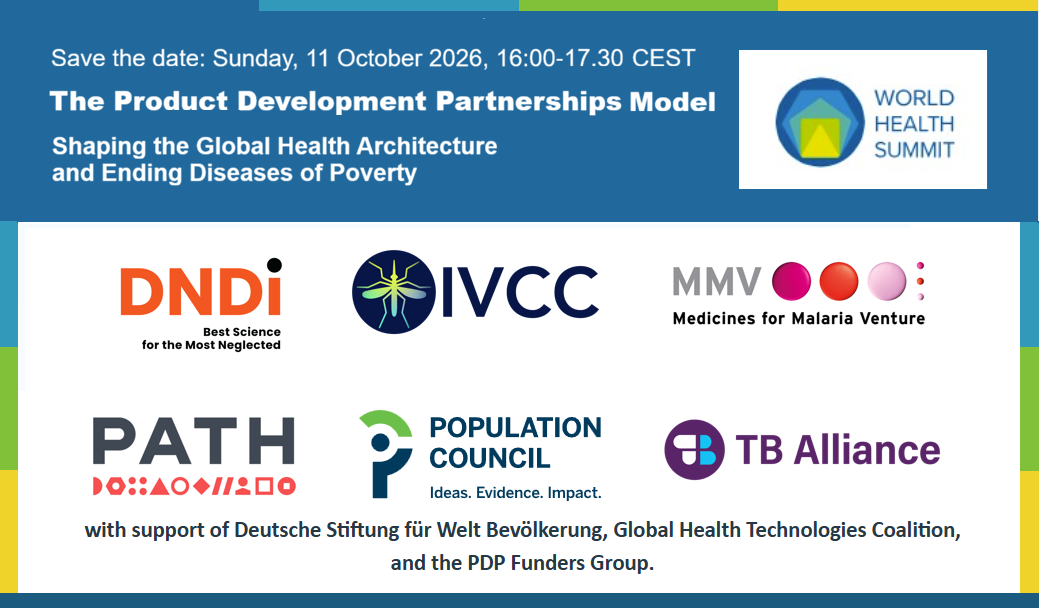
IVCC is co-hosting a side event together with Medicines for Malaria Venture (MMV), Population Council (Center for Biomedical Research) and TB Alliance with support of Deutsche Stiftung für Welt Bevölkerung, Global Health Technologies Coalition and the PDP Funders Group.
Title: The Product Development Partnerships model and its role in shaping global health architecture and ending diseases of poverty
Date: 11th October, 2026, 16:00 – 17:30
Venue: InterContinental Berlin, Budapester Straße 2, 10787 Berlin
Note:
- Seats are on a first come, first served basis.
- In-person attendance requires registration for the World Health Summit.
- The session will be livestreamed via YouTube and is free access. See the WHS website for details.
Abstract
The global health landscape is undergoing profound disruption while neglected diseases continue to endanger billions of the world’s poor. In response to constrained resources, funders are calling for transforming global health architecture through approaches such as downsizing and mergers. Though appearing effective, these could undermine the specialized, access-oriented innovation needed to address neglected diseases— areas where incentives are insufficient to drive private sector investment.
Product Development Partnerships (PDPs) have developed and made accessible over 85 new medicines, vaccines, vector control, diagnostics and sexual and reproductive technologies that have benefitted over 2.4 billion people in low-income countries.
This achievement highlights the strength of the PDP model as adaptable and efficient, aligning public, private, and endemic-country actors around shared health goals. In doing so, PDPs operationalize these key priorities:
- Comparative advantage: Their R&D expertise provides a comparative advantage of filling the innovation gap within the changing architecture:
- Equity and access: embed access provisions from the outset, ensuring innovations reach needy populations;
- Resilient systems: contribute to increasing global R&D capacity and strengthening health systems;
- Innovation with impact: reduce R&D risk and accelerate development of innovations that have contributed to elimination;
- Trusted partnerships: provide platforms for sustained collaboration across geopolitical and institutional boundaries;
- Country leadership: work with endemic country leaders in defining products and sustaining gains.
This session will explore the place of PDPs within the evolving global health architecture, highlighting the value of the PDP model in delivering accessible innovations and exploring areas where the model must evolve to respond to the changing realities.