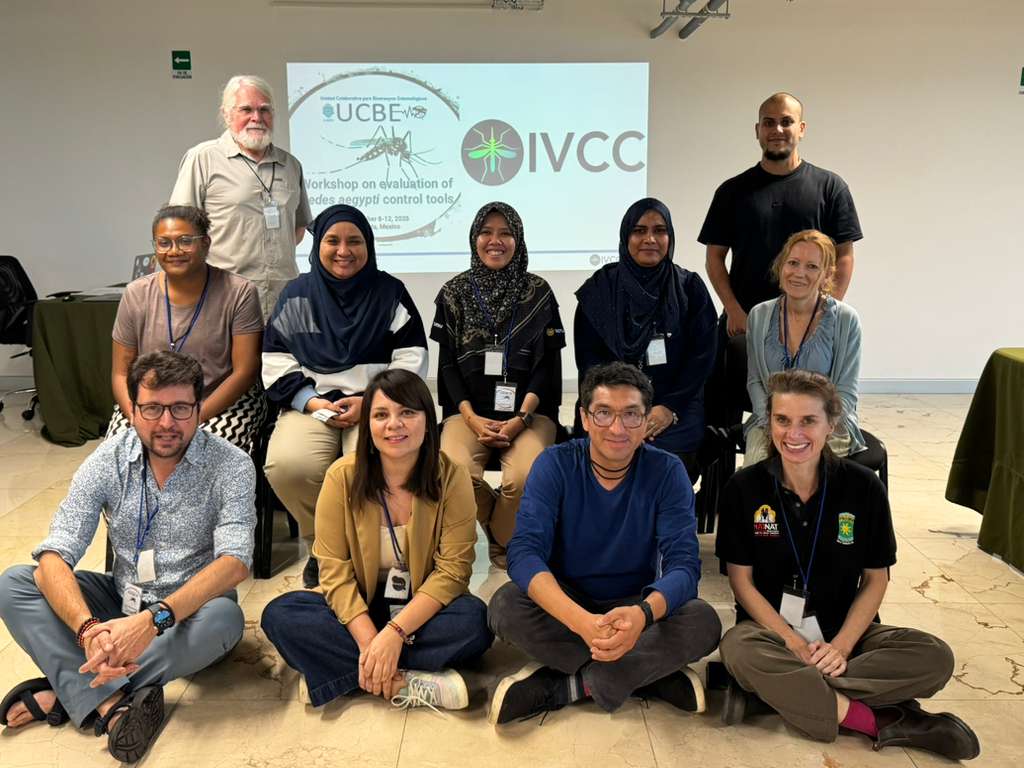
In December 2025, researchers travelled to Mexico’s Yucatán peninsula to exchange knowledge on controlling Aedes mosquitoes.
Partners shared techniques and experience to help countries strengthen their response to mosquito borne diseases, including dengue, chikungunya, yellow fever and Zika. Knowledge exchange between regions is critical as these diseases expand into new geographies.
IVCC supported a five day workshop hosted by the University of Yucatán, bringing together partners from Universiti Sains Malaysia, the Malaysia Institute for Medical Research, the Papua New Guinea Institute of Medical Research, and the Ifakara Health Institute in Tanzania.
The Collaborative Unit for Entomological Bioassays (UCBE), based at the Campus de Ciencias Biologicas y Agropecuarias of the Universidad Autonoma deYucatan, is a global leader in adapting and evaluating spatial emanators and targeted indoor residual spraying for Aedes mosquitoes.
The workshop combined field and experimental house activities. Teams evaluated spatial emanators and targeted indoor residual spraying. They practised Aedes mosquito collection and age grading techniques.They also tested an AI assisted photonic fence to analyse free flying mosquito behaviour around vector control products.
Partners also discussed national product registration, trial design, implementation research, and advocacy to support the Ministry of Health adoption and deployment.
This work supports IVCC product development and access across spatial emanator and indoor residual spraying product classes. Strengthening evaluation capacity and trial readiness in endemic settings helps speed up the pathway from product development to country deployment. This is increasingly important as climate change expands the geographic range of Aedes mosquitoes.