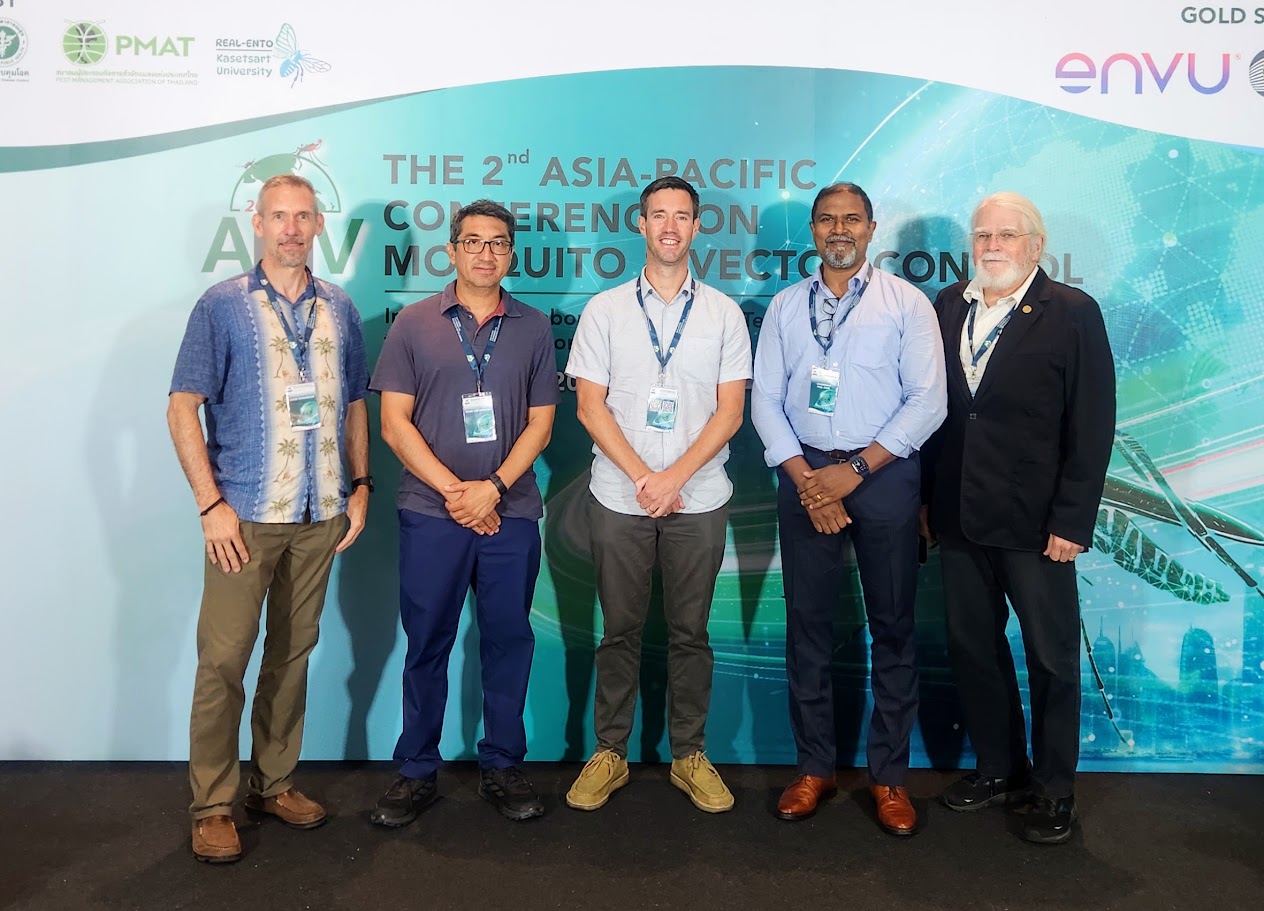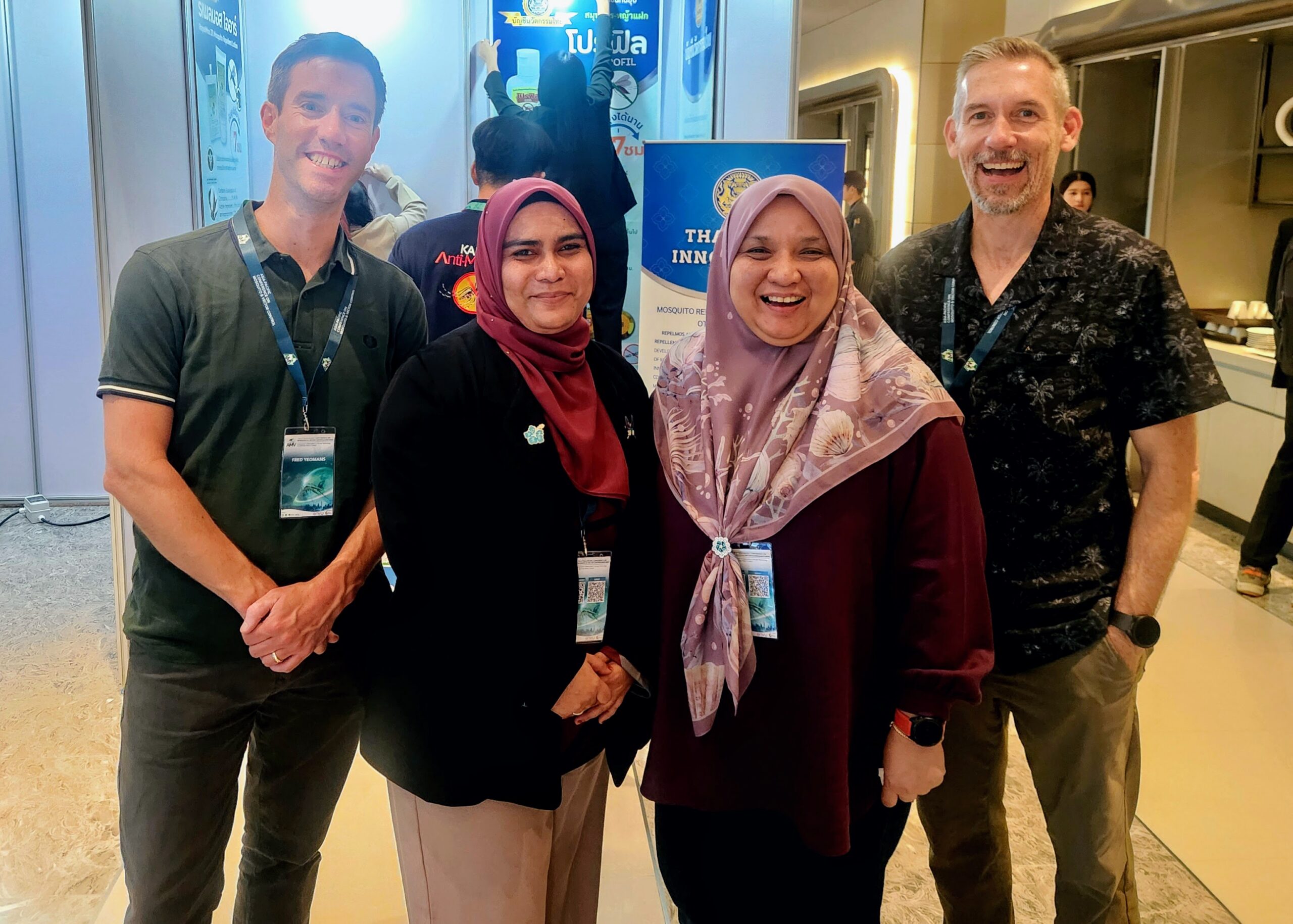
IVCC joined vector control experts from across Asia-Pacific and beyond at the 2nd Asia-Pacific Conference on Mosquito and Vector Control (AMV), held in Pattaya, Thailand, from 5 to 7 August 2026.
Organised by Kasetsart University and partner organisations, AMV 2026 brought together researchers, public health leaders and vector control specialists to share knowledge and strengthen regional collaboration. Key themes included artificial intelligence and automated vector surveillance, insecticide resistance, zoonotic malaria and dengue, and novel vector control tools.
Spatial emanators were a major focus of IVCC’s participation, with IVCC hosting a dedicated symposium chaired by Jason Richardson.
The symposium, ‘Maximising a New Vector Control Paradigm: Spatial Emanators from AI Development to Market’, explored the pathway from research and evidence generation to community engagement and adoption. IVCC’s Fred Yeomans presented on enabling the adoption of multi-active ingredient spatial emanators in the Indo-Pacific and Africa.
Other presentations explored the effectiveness of spatial emanators in reducing human-mosquito contact in Papua New Guinea and the role of community engagement in supporting their development for Aedes aegypti control. Partners also shared work to develop an evidence framework for spatial emanators for dengue control in Penang, Malaysia, and to screen new volatile active ingredients that could sustain their effectiveness.
Beyond the symposium, the IVCC team met regional partners to strengthen collaboration through the Indo-Pacific Initiative and discuss future areas of work.
This included discussions with the NATNAT team, which brings together the Papua New Guinea Institute of Medical Research, James Cook University and the Burnet Institute. NATNAT has established Papua New Guinea’s first national infrastructure for testing novel vector control tools. Its current work includes evaluating spatial emanators and embedding a Quality Management System at the Papua New Guinea Institute of Medical Research, helping to strengthen the evidence and capacity needed to support their adoption.
IVCC also met partners from the Vector Control Research Unit at Universiti Sains Malaysia, the Institute for Medical Research Malaysia and the Collaborative Unit for Entomological Bioassays at the Universidad Autónoma de Yucatán.
Meetings were also held with representatives of Thailand’s Ministry of Public Health and Kasetsart University to discuss the potential adoption of spatial emanators in Thailand.
AMV 2026 gave IVCC an important opportunity to strengthen regional engagement, exchange knowledge and explore how partners can work together to expand access to effective vector control tools across the Asia-Pacific.