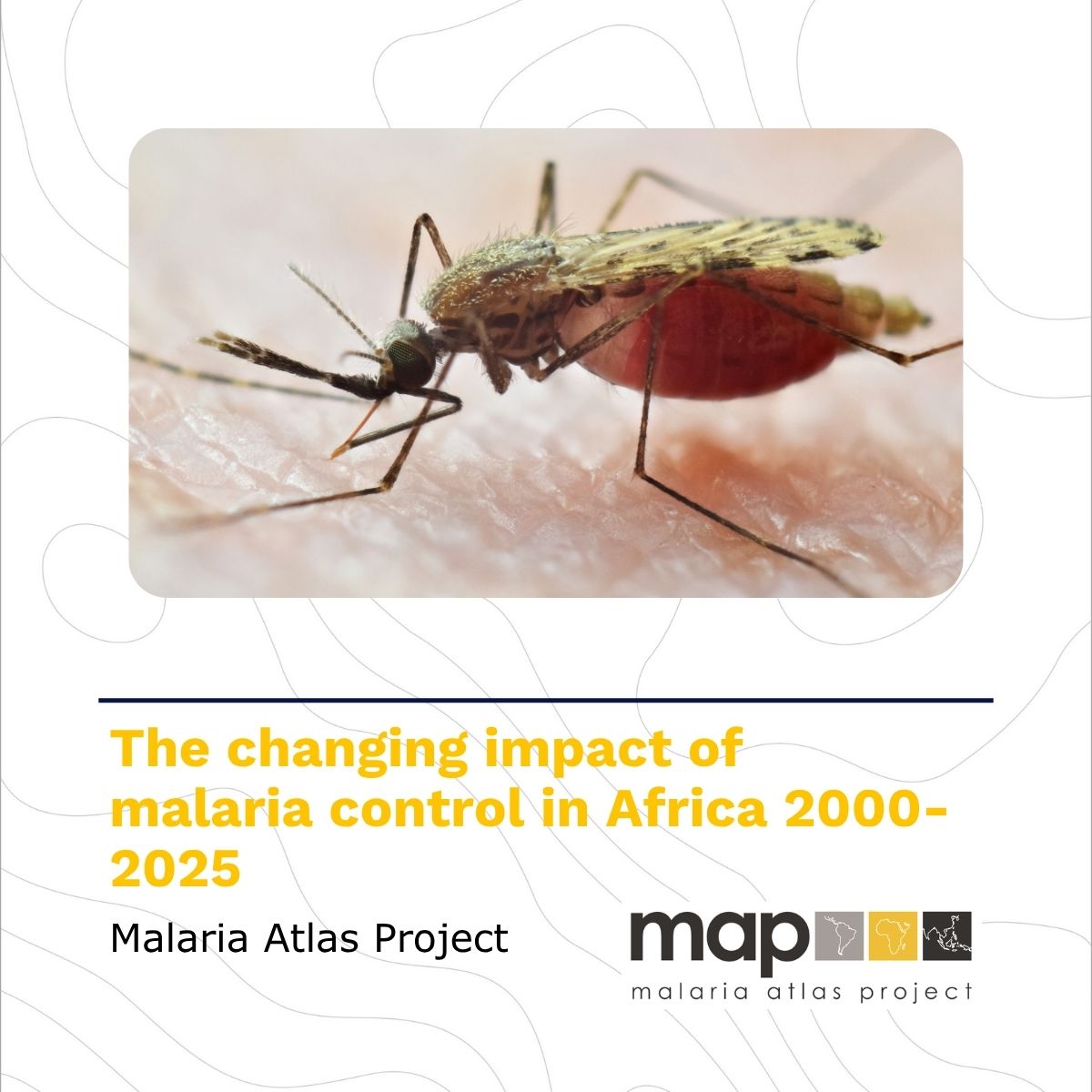
Two decades of data reveal how mosquito control innovations have reshaped the global fight against malaria.
Liverpool, 10 November 2025. Over the past two decades, tools such as insecticide-treated nets and indoor residual spraying have been the single greatest driver of progress against malaria worldwide.
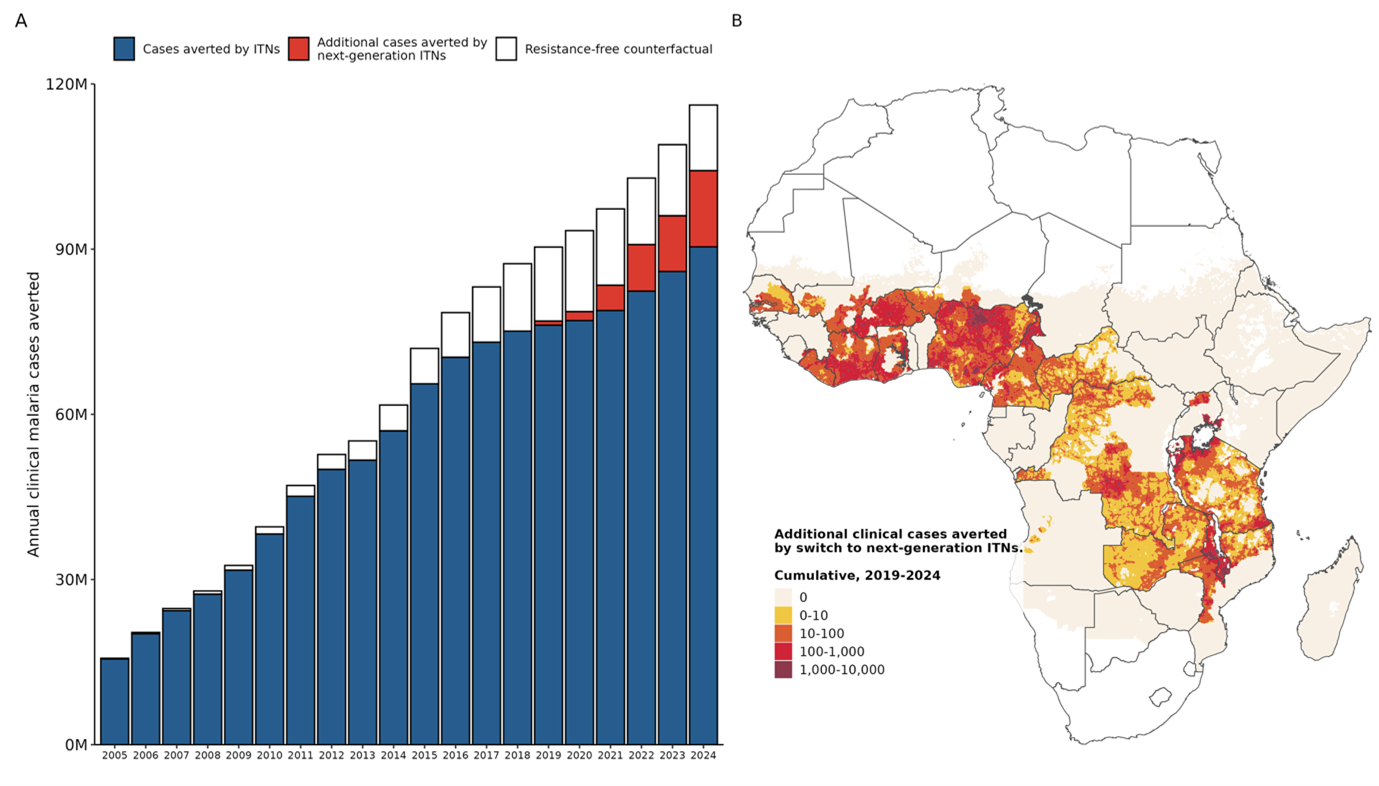
The pre-published research (pre-print), The changing impact of malaria control in Africa 2000-2025, finds that vector control interventions have averted 1.22 billion malaria cases and 3.5 million deaths across Africa over the past 25 years; more than any other malaria intervention evaluated. Next-generation mosquito nets alone have prevented 40 million additional cases since 2019, further accelerating progress against the disease.
While vector control remains the cornerstone of malaria prevention, the research also highlights the complementary role of other tools, such as effective treatments and seasonal malaria chemoprevention (SMC), in sustaining gains and shaping malaria control strategies.
Conducted by the Malaria Atlas Project (MAP), with support from the Innovative Vector Control Consortium (IVCC), the research provides a comprehensive assessment of how mosquito control interventions have reduced malaria transmission across Africa.
Vector control: the cornerstone of malaria progress
The analysis finds that malaria control interventions – insecticide-treated nets (ITNs), indoor residual spraying (IRS), artemisinin-based combination therapy (ACTs) and seasonal malaria chemoprevention (SMC) – have averted approximately 1.6 billion malaria cases since 2000, of which 77.7% were prevented through vector control measures (ITNs and IRS).
The scale-up of ITN coverage accounted for the majority of cases averted by malaria control, preventing 1.13 billion cases, while IRS prevented a further 85 million cases. Since 2000, an estimated 3.5 million malaria deaths have been prevented by vector control, representing over 50% of all malaria deaths averted over the past 25 years.
Researchers used advanced geospatial modeling techniques (including hierarchical Bayesian methods) to estimate the impact of malaria control interventions from 2000 to 2025. The analysis drew on two decades of epidemiological, intervention coverage, and environmental data to account for a wide range of factors that influence malaria transmission.
“This study provides updated evidence that vector control has been the backbone of global malaria progress”, said Justin McBeath, Chief Executive Officer at IVCC. “As new resistance patterns emerge, next-generation tools are essential to protect these gains and move closer to malaria elimination. IVCC continues to work with partners to accelerate the development and deployment of next-generation vector control products that can overcome insecticide resistance and protect the most vulnerable communities”
Professor Peter Gething, Co-Head of the Malaria Atlas Project at the Malaria Atlas Project, commented: “Our findings show that continued investment in vector control is critical. Without it, the remarkable reductions in malaria cases and deaths since 2000 could be reversed.”
The results offer an important evidence base for governments, donors and global health partners working to prioritise investments in malaria control. By showing where interventions have been most effective, the study supports data-driven decisions at both global and national levels — helping countries to refine their malaria strategies and sustain progress towards shared global targets.
For further information, please contact:
Chris Larkin, Director, Communications and Operations
Christopher.larkin@ivcc.com
(+44) 07712 402498
About the report
Evaluating the Impact of Vector Control in Africa was conducted by the Malaria Atlas Project, supported by the Innovative Vector Control Consortium (IVCC). This analysis estimates the relative contributions of key malaria control interventions across Africa over the past 25 years using high-resolution spatio-temporal models and comprehensive datasets on malaria epidemiology and control since 2000.
The pre-print publication can be found here: https://d3j3by4g65v3w3.cloudfront.net/The+changing+impact+of+malaria+control+in+Africa+2000.pdf
About MAP
The Malaria Atlas Project (MAP) is an international research collaboration that tracks the global fight against malaria. Since its inception in 2006, the MAP collaboration has comprised of many scientists working in groups around the world. Today, MAP has a core team based at the Kids Research Institute Australia and Curtin University in Perth, Western Australia, and Ifakara Health Institute in Dar es Salaam in Tanzania, and has members in Europe, the United States, Africa and Asia.
MAP is also a designated World Health Organization Collaborating Centre in Geospatial Disease Modelling. Through this partnership we provide modelling and analysis both directly to the WHO Global Malaria Program and via WHO to individual countries.”
Website: malariaatlas.org
About IVCC
IVCC is the only Product Development Partnership (PDP) focused on solutions for vector control. IVCC was established in 2005, through an initial grant to the Liverpool School of Tropical Medicine (LSTM) from the Gates Foundation. As a registered charity in the UK, IVCC receives grant funding from the Gates Foundation, UK Aid, The Swiss Agency for Development and Cooperation and the Australian Department of Foreign Affairs and Trade to partner with different stakeholders across industry, scientific institutions and endemic countries to facilitate the development and availability of novel and improved public health insecticides and formulations which can combat the rapidly growing problem of insecticide resistance.
Website: ivcc.com
X (Twitter): @invectorcontrol
LinkedIn: IVCC (Innovative Vector Control Consortium)