Last month, Dr Julie-Anne Tangena, Technical Manager, Market Evidence and Product Performance, at IVCC, presented IVCC’s work at an RBM Partnership to End Malaria webinar titled Improving post-market ITN surveillance for decision making, in collaboration with Alliance for Malaria Prevention (AMP), Tropical Health and Clinton Health Access Initiative (CHAI) on the Post-Market Surveillance (PMS) Toolkit, developed in response to increasing challenges in understanding insecticide treated net (ITN) durability and performance in real world settings.
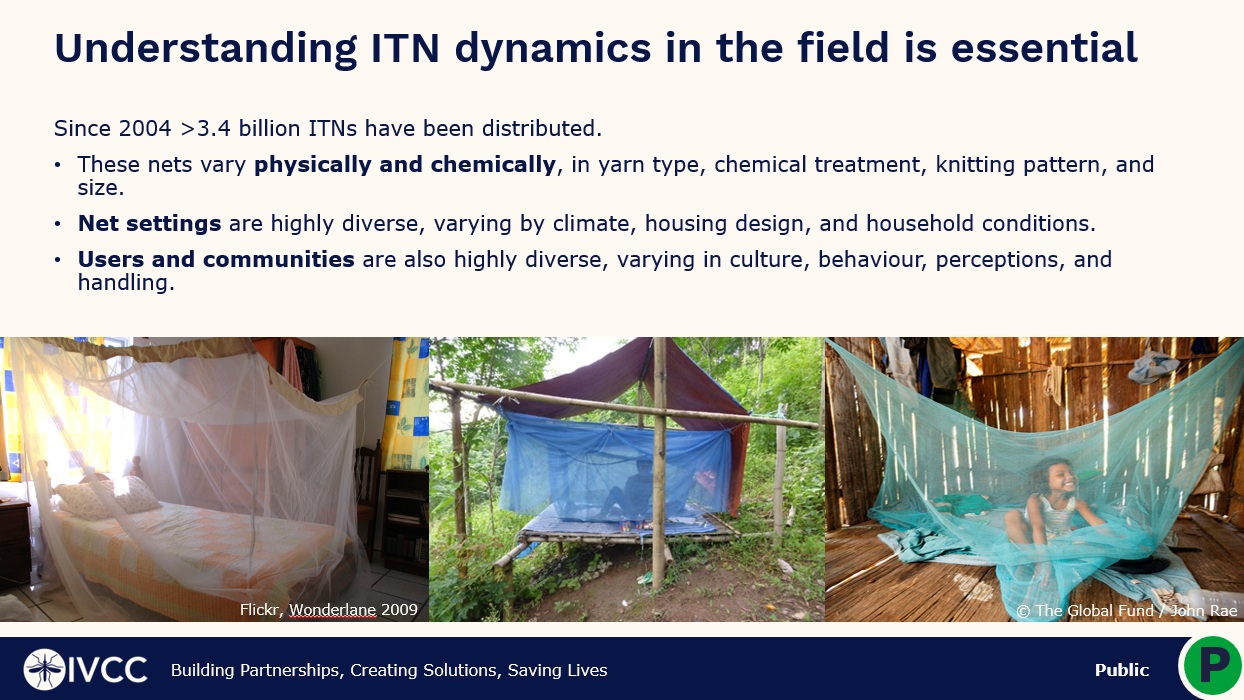
Since 2004, over 3.4 billion ITNs, varying widely in their physical and chemical characteristics, have been distributed across diverse environments and communities. Recent evidence shows that many ITNs last less than two years, far below the expected three-year lifespan. However, comprehensive net durability monitoring is expensive, technically demanding, and increasingly constrained by limited funding.
Consultations conducted with national programmes in multiple countries highlighted a strong need for more practical, decision-focused guidance on ITN durability. Programmes expressed a desire for more granular data to support targeted decisions, especially when resources are scarce, and stressed the importance of ensuring collected data directly informs decision-making rather than remaining underutilised. This led to the development of the PMS Toolkit by Innovation to Impact (I2I), who initially led this initiative. The toolkit is a structured, modular resource designed to help countries prioritise indicators, select appropriate study designs, and align monitoring activities with programmatic decision-making. By 2026, the toolkit will be available on the AMP webpage as part of a collection of AMP toolkits aimed at improving ITN access and use.
The toolkit is organised into five modules guiding users through defining key questions, selecting indicators, identifying available data, determining study methods and resource requirements, and planning response pathways. By helping programmes tailor ITN durability surveillance to their context and constraints, the toolkit aims to strengthen procurement, distribution planning, and overall vector control strategy. Ultimately, the PMS Toolkit supports evidence-based decision-making by helping National Malaria Programmes assess ITN performance, understand factors affecting durability, and take timely, data-driven action to strengthen vector control strategies.
The presentation can be downloaded here.