Every night, hundreds of millions of people across sub-Saharan Africa sleep under an insecticide-treated net (ITN) to protect themselves from malaria. However, many of these nets do not last as long as intended.
A new World Health Organization (WHO) consultation report highlights evidence that a lab-based metric can help predict how long a net could last in real-world conditions. IVCC supported the consultation that informed the report. Improving physical durability could reduce malaria cases and improve value for money.
Why this matters for malaria control
The findings could help malaria programmes and procurers make better decisions about which nets to buy. If nets last longer in real-world conditions, they can provide more consistent protection, reduce the need for replacement, and improve value for money across distribution campaigns.
The problem with net survival
Bed nets are typically distributed at 3-year intervals, yet recent research has shown they last considerably shorter. The median field retention time is just 1.64 years, with substantial variability across countries and net types, according to analysis done by the Malaria Atlas Project (Bertozzi-Villa et al., 2021). To ensure continuous protection, nets must remain physically intact and consistently used throughout their intended lifespan.
Previously, the physical durability of nets could not be assessed prior to distribution, as field data is heavily influenced by local environmental and behavioural factors. This meant procurers had no reliable way to distinguish between more and less durable nets before deployment, limiting market incentives to invest in improved physical durability. Experts involved in the consultation also noted that greater incentives in procurement are needed for design innovations to be brought to market.
What is the RD score?
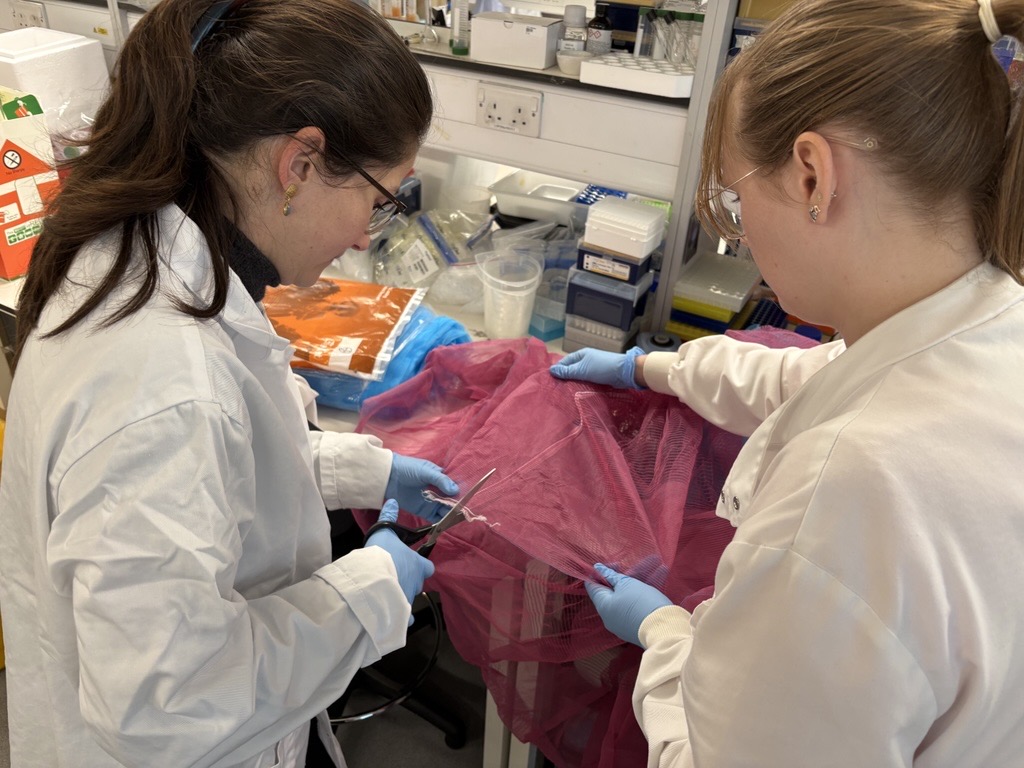
The Resistance to Damage (RD) score is a laboratory-based metric that measures a net’s physical durability before it reaches the field. It draws on three textile tests: snag strength, bursting strength, and hole enlargement resistance. These reflect the types of mechanical damage nets commonly experience in households.
The score has recently been refined. Analysis of field-aged nets showed that most mechanical damage is driven by hole enlargement, while abrasion contributed little and produced inconsistent results. The updated RD scoreabrasion and places greater weight on hole enlargement, improving alignment with observed field performance.
What the evidence shows
The consultation report discusses findings from 14 countries, 44 durability monitoring sites, and more than 17,000 observations of nearly 10,000 nets.
The RD score is positively associated with median net survival (p=0.001). Key findings include:
- A 10-point increase in RD score is associated with a 3.5-month increase in median survival.
- A net with a RD score of 38 has a median survival of around 1.6 years, while a net scoring 68 reaches approximately 2.7 years.
- Aspirational nets with RD scores of 80 to 85 can reach around four years of median survival, with a 70% lower hazard of failure compared to standard nets.
These findings have practical implications. Modelling suggests that a three to four-month improvement in net survival, equivalent to a 10-point RD increase, could reduce malaria cases in sub-Saharan Africa by 5 to 6% over three years. To achieve the same impact through distribution alone would require an additional 171 million nets.
Together, the RD score and Risk Index (RI) could support more value-based procurement approaches that consider the cost per year of protection, rather than upfront price alone. This value is not currently reflected in procurement decisions, despite WHO-prequalified nets already showing a wide range of RD scores independent of price.
The Risk Index: understanding real-world use
The RD score measures physical durability under controlled conditions. However, net survival is also shaped by how nets are used and cared for in the home. The same net in different environments can result in median lifespan differing by more than two years.
captures the social and environmental factors that influence net durability, including behaviours such as cooking or storing food in sleeping areas, as well as housing conditions and exposure to rodents. It helps explain differences in net survival across locations for the same net type.
Analysis shows that a 10-point reduction in RI score is associated with a 2.2-month increase in median survival. While the RI shows strong potential, further development is needed before it can be used in procurement and decision-making processes.
What happens next
IVCC played a key role in advancing this work, completing analyses and supporting preparations for the WHO consultation, including after the conclusion of the Innovation to Impact initiative (I2I).
IVCC’s contribution included participation in the WHO technical consultation through colleagues across the technical development team, including Christen Fornadel, Senior Technical Coordinator, who served as a temporary advisor, alongside contributions from Julie-Anne Tangena, Technical Manager, and Frank Mechan, Technical Officer.
IVCC is now supporting the next phase of work. This includes refining RD score testing protocols, developing approaches to assess novel net designs, and supporting efforts to further standardise laboratory methods through an internationally recognised process. IVCC is also collaborating with Tropical Health to further develop the RI. In parallel, IVCC is continuing work to better understand the chemical durability of nets.
Together, this work aims to support more balanced, evidence-based decision-making across key insecticide-treated net performance factors.
In the meantime, the WHO report suggests that procurers may begin integrating the RD score into their decisions alongside other relevant product considerations. Over time, preferred product characteristics that specify aspirational RD scores could help inform durability standards and encourage a shift across the net landscape to more durable nets.
The WHO technical consultation report, Technical consultation on physical integrity and durability of insecticide-treated nets, is available on the WHO website.
These findings highlight the importance of net durability in malaria control and support more informed decision-making across programmes.
* Referenced in the paper as weighted RD score (wRD) to differentiate from the old RD score (oRD)